
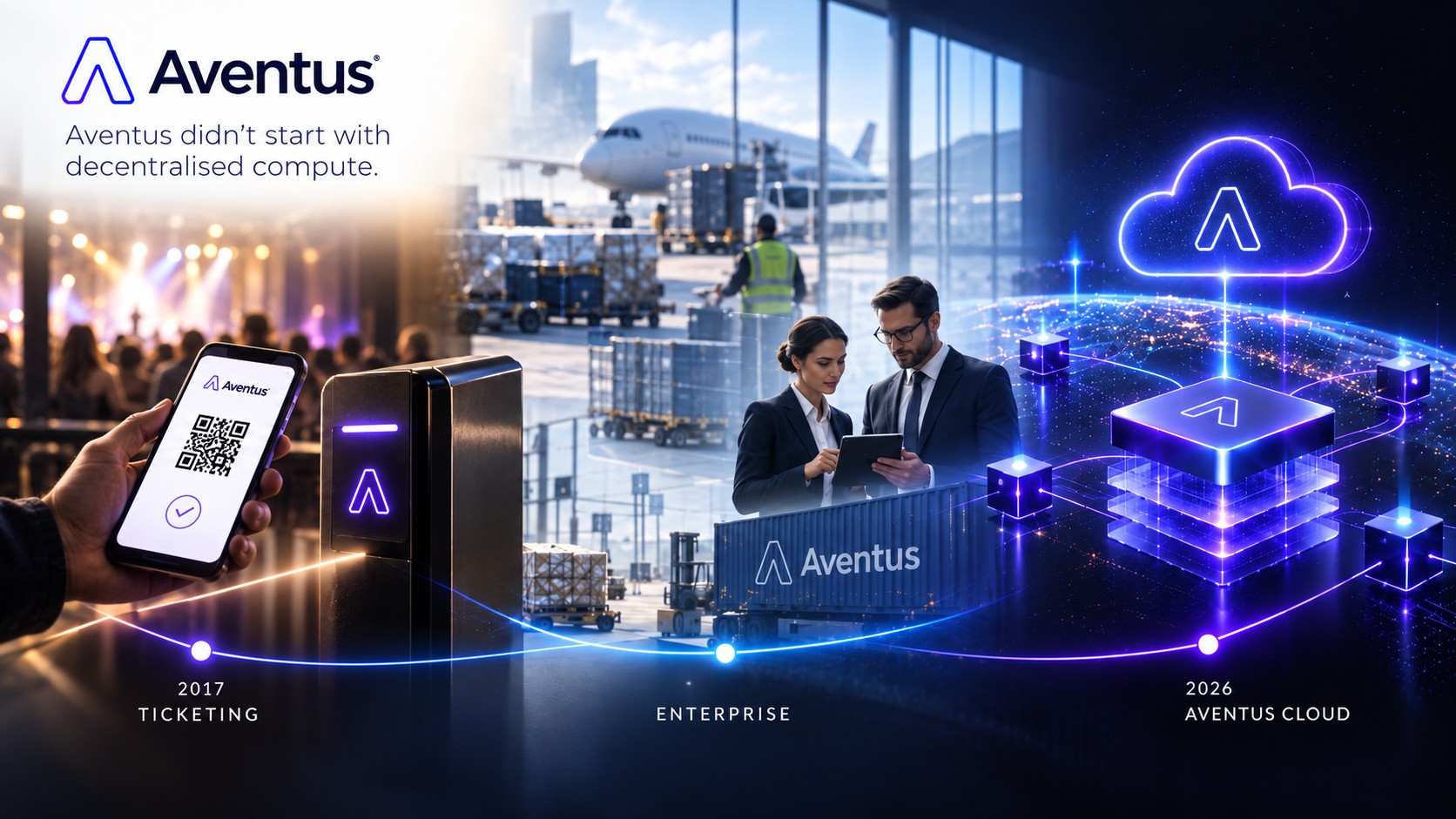
Illustrative journey: ticketing, enterprise blockchain infrastructure and Aventus Cloud.
In 2017, Aventus started with something familiar: a ticket.
A ticket appears simple until it changes hands. The issuer needs to know it is genuine. The buyer needs confidence that it will be accepted. The venue needs an accurate record of ownership. If the ticket is resold, several parties may need to agree on the price, the transfer and how revenue should be divided.
At the time, those processes were fragmented. Once a ticket entered the secondary market, issuers often lost visibility and control. Buyers faced fraud, inflated resale prices and limited ways to establish whether a ticket was legitimate.
Blockchain offered a different way to manage that lifecycle.
The original Aventus Protocol was built as an open-source system on Ethereum. It gave ticketing organisations tools to define rules around initial pricing, resale limits and revenue distribution, while creating a verifiable record as ownership moved from one person to another. The aim was never to make customers think about blockchain. It was to make ticketing more transparent, accountable and efficient.
A technology becomes useful when it improves a product people already understand.
It also raised a much larger question.
If the application worked, could the infrastructure beneath it support real demand?
The application exposed the infrastructure
Ticketing did not only test the product. It tested the network underneath it.
A high-demand event can bring thousands of buyers into a system at once. Transactions need to be processed quickly. Costs need to remain predictable. The experience cannot fall apart because the underlying blockchain becomes congested.
Privacy matters too. Businesses need to control commercially sensitive information while still being able to prove that important events and transactions took place correctly.
By 2018, we had begun work on Aventus Network. The goal was to create an infrastructure layer capable of supporting the original ticketing vision and a much wider range of applications, with greater scale, privacy and control.
The move from a ticketing protocol to a network was not a departure from the original idea. It was a response to what building the product had taught us.
Useful applications need infrastructure designed around the way they actually operate.
That means more than processing transactions quickly. It means predictable costs, reliable finality, the ability to integrate with existing systems and enough flexibility to support different commercial requirements.
Over the following years, Aventus Network developed into a Substrate-based blockchain with interoperability between the Polkadot and Ethereum ecosystems. In December 2023, the live network completed its migration and became a fully functioning Polkadot parachain. Moving an existing blockchain, including its accumulated state, was a substantial engineering project in its own right.
That phase gave Aventus a stronger technical foundation.
The next phase changed how we thought about the work itself.
Production changed the standard
There is a considerable difference between demonstrating that a blockchain application can work and operating infrastructure that a business depends on.
Production environments are less interested in the novelty of the technology. They care about whether it can integrate with existing systems, remain available, support the required volume and deliver an outcome that justifies the cost.
As Aventus expanded beyond ticketing, our work reached rewards and loyalty, energy infrastructure, supply chains, media and prediction markets.
Those deployments brought the technology into business processes with real users and commercial consequences.
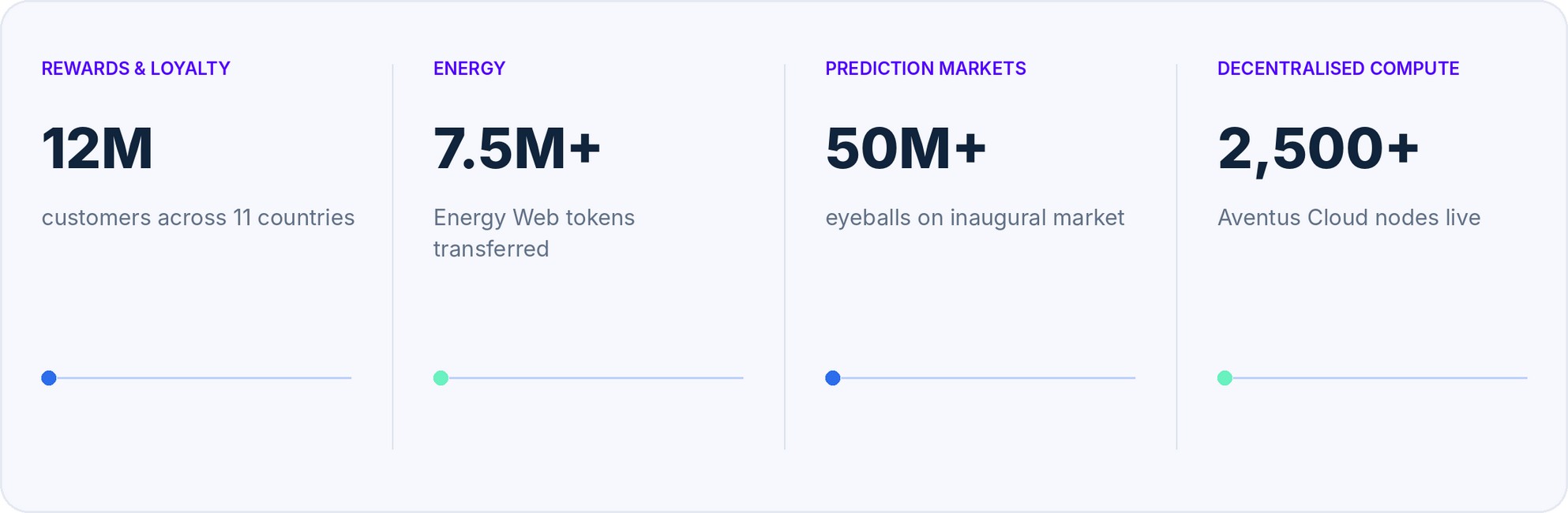
Selected production outcomes reported across Aventus case studies and Aventus Cloud.
Aventus infrastructure supporting Enigmatic Smile and Voucher Ledger reached 12 million customers across 11 countries. Work with Energy Web transferred more than 7.5 million tokens without interruption and supported a network of over 800 active worker nodes. Predictor Network demonstrated how dedicated blockchain infrastructure could support a large media and prediction-market ecosystem, with its inaugural market reaching more than 50 million people.
The industries were different, but the operational requirements had a great deal in common.
The infrastructure had to fit the business.
Integrations had to work with systems already in place. Transaction costs had to make sense at the level of the individual use case. Business rules needed to be represented accurately rather than forced into a generic model. The software needed to remain maintainable after launch. When something went wrong, responsibility needed to be clear.
These were not secondary concerns. They determined whether the technology could remain in production.
The experience also clarified something that is easy to miss when discussing blockchain at a purely technical level.
A blockchain may establish agreement about the state recorded on that chain. A useful application usually depends on much more.
It may need information from an external system.
It may need a market outcome confirmed.
It may need a calculation performed using rules specific to the business.
It may need a summary checked before another system accepts it.
It may need several organisations to rely on the same result without giving any one of them exclusive control over how that result is produced.
The chain is part of the infrastructure. It is rarely the whole of it.
Business logic needed its own environment
Enterprise deployments also showed us the limits of trying to place every application inside the same general-purpose environment.
Different businesses have different requirements for governance, privacy, transaction economics, finality and control. A rewards platform does not operate in the same way as an energy network. A prediction market has different rules from a supply-chain system.
That is where the appchain model becomes useful.
An Aventus Enterprise Appchain gives an application its own blockchain environment, shaped around its business logic. Built with Substrate, it allows rules to be written directly into the runtime rather than approximated through a collection of generic smart contracts. The chain can have its own governance, token model, fee structure and operational configuration.
This gives businesses greater control over the part of the infrastructure that is specific to them.
It also creates another practical question.
What happens when an appchain needs work performed outside the chain itself?
An application may need an external price, event result or data point. It may need a state summary independently verified. It may need specialised logic executed at regular intervals.
Placing that work behind one centrally operated server may be convenient, but it introduces a point of dependency into a system designed to reduce reliance on individual parties.
Building an entirely separate decentralised network for every application is possible. It is also expensive, slow and operationally demanding.
A project would need to develop the software, recruit operators, design incentives, coordinate upgrades and earn the confidence of a new technical community, all before that network begins performing the work it was created to do.
We saw an opportunity for shared infrastructure.
The missing layer around the chain
Aventus Cloud grew from a problem we had encountered repeatedly.
Applications needed access to decentralised execution and verification, but the work did not always belong inside the chain. It also did not justify building another network from the ground up.
The answer was a compute layer that multiple systems could use.
The Aventus community approved the framework for Aventus Cloud and the Aventus DAO in October 2025. The network went live on mainnet in April 2026. Today, more than 2,500 nodes are live, with the architecture designed to scale towards a network of 40,000.
Aventus Cloud is operated by the people running those nodes around the world. The node software can run on ordinary computers across macOS, Windows and Linux, with Docker available for server environments.
When a connected system submits a work request, the network coordinates how that work is distributed, executed and returned.
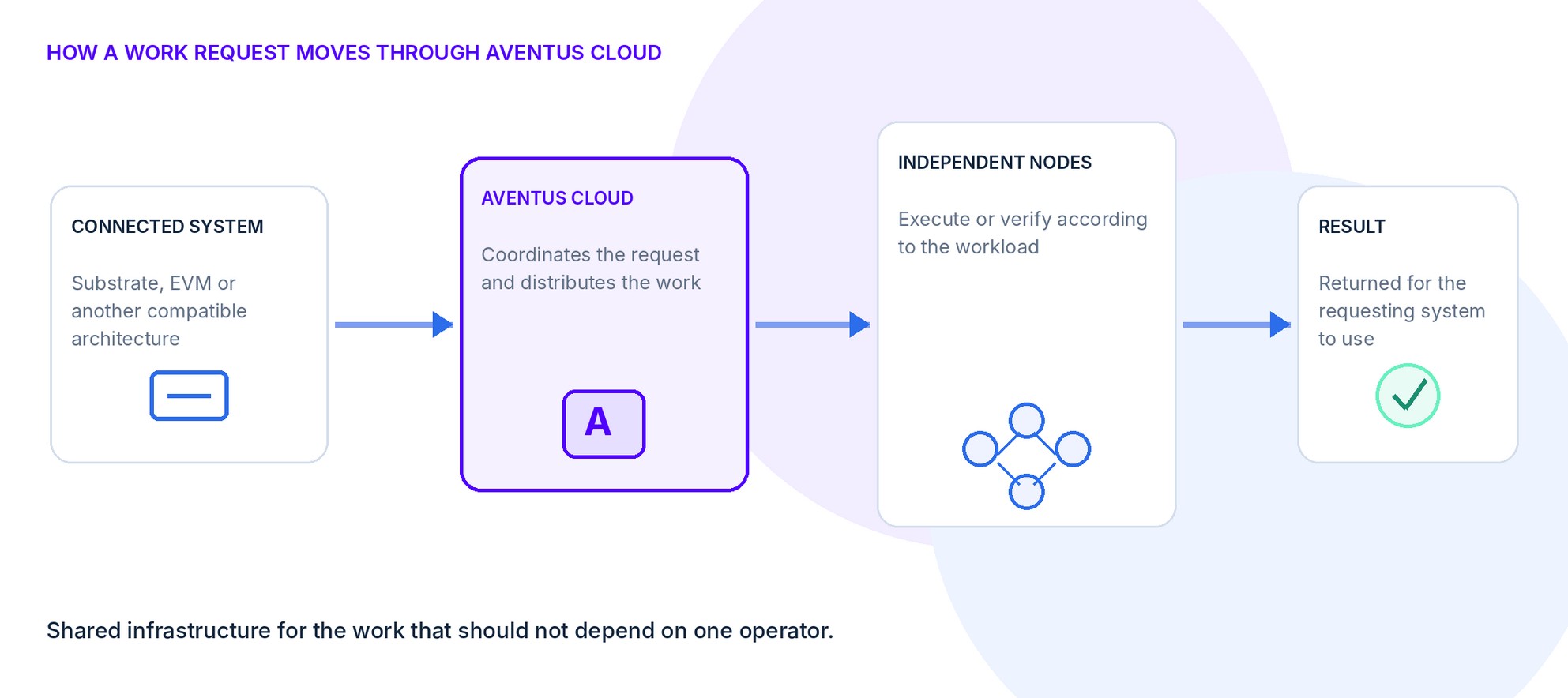
A simplified view of the shared compute model.
Decentralised oracle services: allow an application to request information that cannot be established from its own onchain state. That could include a token price, a sporting result or the outcome of a prediction market.
Summary verification: allows independent nodes to check a state summary before another system relies on it. We use this mechanism today to verify the Aventus Parachain’s weekly summary to Ethereum.
Custom business logic execution: allows an application to distribute specialised computation across the network rather than placing critical logic behind one centrally controlled backend.
These are focused capabilities by design.
Not every calculation benefits from decentralisation. Many workloads are served perfectly well by conventional cloud infrastructure.
The case becomes stronger where independence changes the quality of the result.
If several parties depend on an outcome, independent execution can provide a better basis for agreement. If a state summary will be accepted by another chain, separate verification can reduce reliance on the submitting party. If critical business logic should not sit behind one server, a distributed operator network creates another option.
Aventus Cloud is built for the work that should not depend on one operator.
A shared network changes the economics
The shared model has an important practical advantage.
A connected application does not need to build separate infrastructure for every decentralised workload. The same network can support oracle requests, summary checks and configurable business logic for many different systems.
That reduces duplication.
Developers can concentrate on the application and the business rules that make it distinct. Aventus Cloud provides access to an existing operator network, coordination layer and incentive structure.
The model is also designed to work beyond one blockchain architecture. Any compatible system that can submit a work request and read the returned result can use the network, whether it is built with Substrate, EVM technology or another suitable framework.
This is where the pieces of the current Aventus ecosystem come together.
Enterprise Appchains give organisations a dedicated environment for their own rules and applications.
Aventus Cloud provides shared decentralised infrastructure for work that should not depend on one operator.
The people running Cloud nodes provide the machines and availability that make that infrastructure real.
Each part exists for a different reason. Together, they allow businesses to choose the level of control, independence and customisation their application actually needs.
The product changed because the problem widened
It would be easy to describe the Aventus journey as a series of changes in direction.
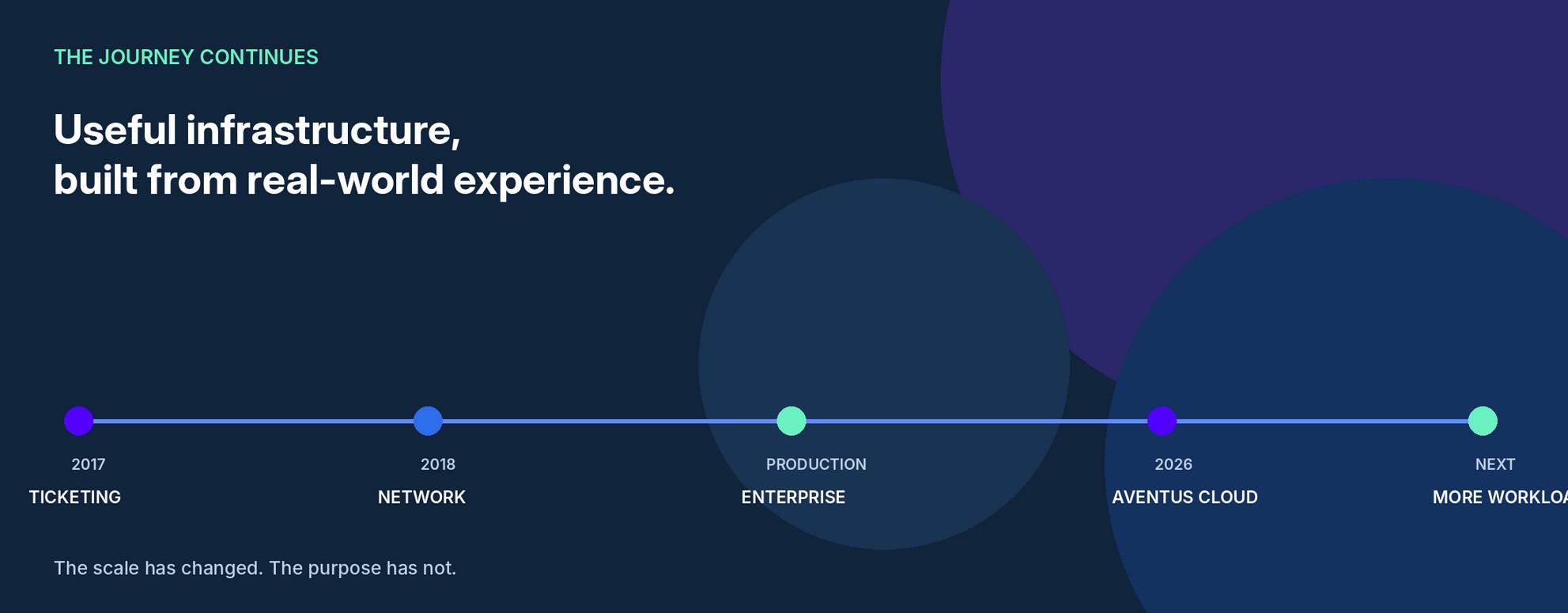
Ticketing. A blockchain network. Enterprise applications. Appchains. Decentralised compute.
From inside the work, the path looks more consistent.
Ticketing taught us to start with a real problem and build around the people experiencing it.
Developing Aventus Network taught us that an application can only be as dependable as the infrastructure underneath it.
Enterprise deployments taught us that technology must operate within commercial, operational and regulatory reality.
Appchains showed us the value of giving each application an environment shaped around its own logic.
Aventus Cloud emerged from the work that remained around those chains: external data, independent verification and specialised execution.
Each stage took us deeper into the same question:
What infrastructure allows organisations to use decentralised technology without having to build and operate every layer themselves?
Our answer has developed through almost a decade of implementation, not in isolation from it.
What comes next
Aventus Cloud is now live. The operator network exists. The first capabilities are available.
The next phase will be judged by the work applications choose to send to it.
That means making integration simpler, supporting workloads that benefit from independent execution and building relationships with projects that already understand the problem they need the network to solve.
It also means continuing to apply the discipline that brought Aventus this far.
Start with the use case.
Understand the operational reality.
Choose the right architecture.
Decentralise the parts where independence and verification create meaningful value.
Aventus began with the lifecycle of a single ticket.
Today, we are building infrastructure that can help many applications coordinate work across systems and participants they do not fully control.
The scale has changed. The purpose has not.
Sources and further reading
This article draws on Aventus’s published history, product documentation, case studies and annual reporting. Network and product figures are current as at October 2026.
- About Aventus
Aventus history from ticketing and Aventus Network to the launch of Aventus Cloud. - Aventus Protocol repository
The original open-source Aventus Protocol implementation and white-paper reference. - Parachain Migration Deep Dive
Aventus engineering account of migrating a live network and becoming a fully functional Polkadot parachain. - Aventus Case Studies
Production outcomes across prediction markets, rewards, aviation and energy. - Enterprise Appchains
Current product architecture and the role of Substrate-based appchains. - Aventus Cloud
Current network capabilities, node software and supported workloads. - Aventus DAO Annual Review 2025-2026
Launch timeline, live-node figure and network capacity.
Aventus DAO
Bringing real-world businesses onchain since 2017.