

Secure, Govern, Scale with AVT.
AVT is the native utility and governance token of the Aventus Network and Aventus Cloud ecosystem.
What AVT is used for.
AVT has been deployed on Ethereum as an ERC-20 token, and also on Aventus Network (a Polkadot parachain).
Aventus Cloud node staking
Stake 10,000 AVT per node to double reward weight via virtual nodes.
Governance
AVT holders vote on governance proposals affecting the community and ecosystem.
Gas fees
Users pay AVT as gas for transactions on the Aventus Network.
LP fees
Provide AVT to a Uniswap pool and earn a share of swap fees from every trade.
Total AVT issued.
Latest recorded figure
The onchain figure updates approximately every 24 hours and is rounded to the nearest whole token. Total supply is not circulating supply — it includes tokens that may be locked, staked, reserved, or otherwise not freely transferable. Provided for information only and may differ momentarily from other trackers due to timing. This is not financial advice.
Where AVT can be acquired.


Move AVT and ERC-20 tokens between Aventus and Ethereum.
The official Aventus Bridge connects the Aventus Network to Ethereum, enabling the transfer of AVT and any supported ERC-20 token between the two networks. The smart contract that powers the bridge has been fully audited by QuillAudits.
Visit bridge.aventus.io, connect a SubWallet or Polkadot.js wallet, choose a token, choose a direction, and submit the transfer.

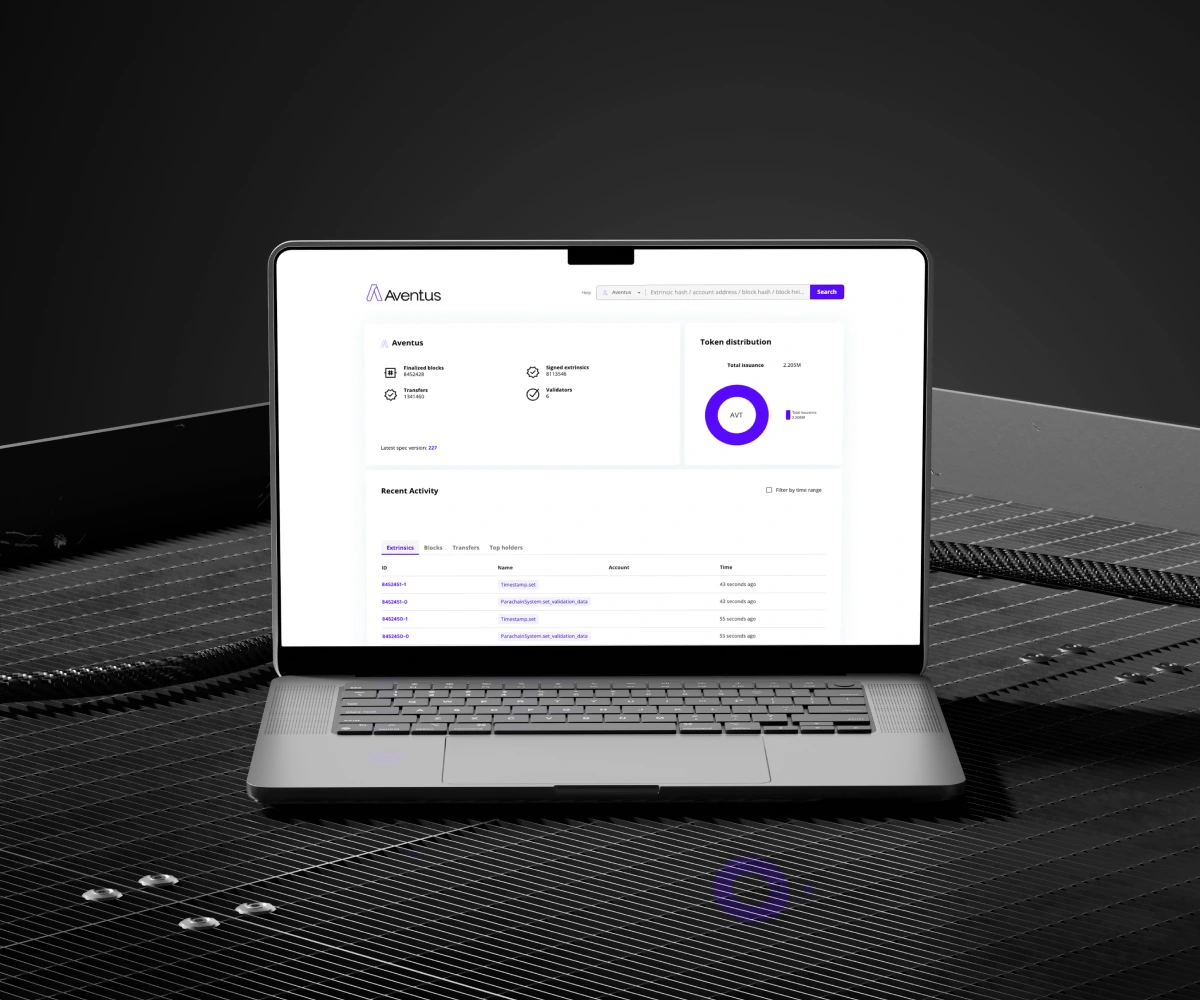
View transactions, blocks, and accounts on the Aventus Network.
The Aventus Network block explorer is available at explorer.mainnet.aventus.io. It provides public access to transaction history, block production, account balances, validator activity, and on-chain governance records.
How AVT holders vote.
AVT holders vote on proposals affecting the Aventus Network and the Aventus Cloud ecosystem through Aventus DAO governance at gov.aventus.io.
Voting takes place onchain. Proposals can be submitted through the governance forum. Quorum and voting weight rules are themselves set by governance and can be amended through future proposals.
- Dec 2025Staked AVT holders receive two times voting weight.
- Dec 2025Proposal quorum raised from 10,000 to 100,000 AVT.
- Nov 2025Restructured Cloud node emissions, and appchain token allocation.
How AVT is distributed to node operators.
The current Aventus Cloud reward model was set by governance proposals #869f3 ↗ and #35d3c ↗.
A fixed daily pool of AVT is distributed across every active node, proportional to each node’s weight. The pool halves annually.
- Year 1: 14,625 AVT per day
- Year 2: 7,312 AVT per day
- Year 3: 3,656 AVT per day
- Year 4 and beyond: continues to halve
Total additional emission over infinite time: approximately 10.68 million AVT.
Per-node yields depend on the number of active nodes, the weight of each node, and uptime. There is no guarantee of any specific yield, and the model can be amended through future governance proposals.
Mechanisms that help reduce circulating supply.
Two mechanisms reduce the freely circulating AVT supply over time:
- Staked AVT locked out of circulation. AVT staked on nodes or for governance weight is removed from circulating supply while staked.
- Community treasury holdings. AVT held by the community treasury is retained for grants and ecosystem development, reducing free float.
Compliance note
This page describes the utility, supply, and mechanics of AVT. It is not a recommendation to acquire, hold, or transact in AVT. AVT is not a financial product. Token holdings, network participation, and any returns from node operation or staking depend on factors outside any single party’s control. Acquisition and holding of AVT may be subject to restrictions in your jurisdiction. Consult a qualified adviser before making any decision.